The programmes

Three audiences.
One adoption gap.

Training is structured around the people who need to use, apply and lead AI - not around a catalogue of product features. Every programme is shaped around your tools, your workflows and your constraints.

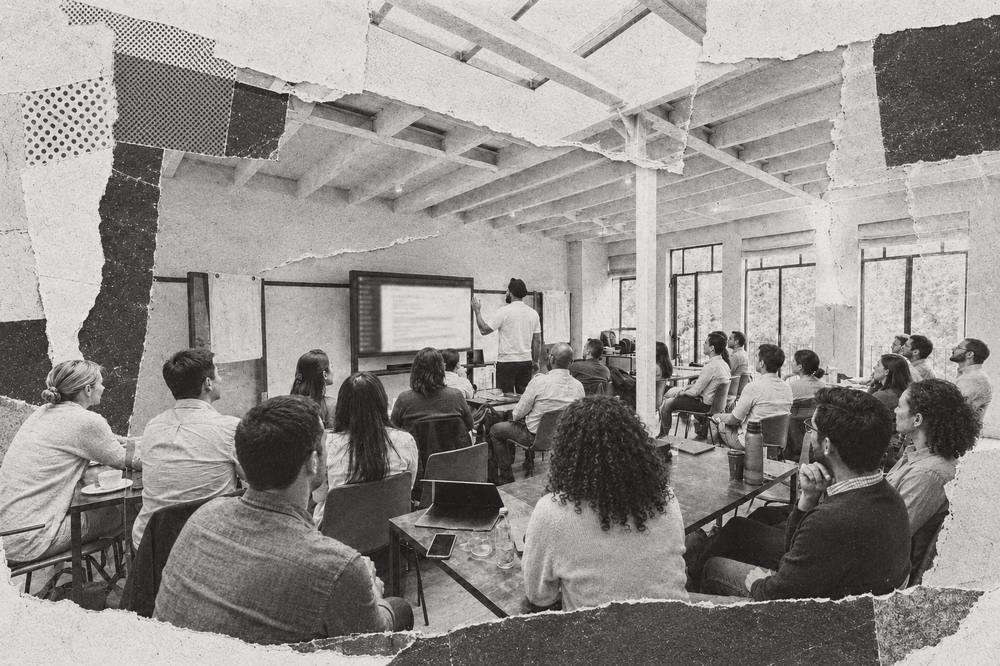
Illustrative greyscale collage of a training session in progress, composed on torn paper

Start here

Which one
fits your problem?

Three questions, same three rows. If more than one applies, that usually means a phased rollout rather than a single session.

For employees

AI foundations for non-technical teams

Who it is for
Whole teams with tool access and no shared starting point.
Choose this when
Usage is patchy, inconsistent or quietly avoided.
They leave with
Confidence, judgement and a workflow they have already run.
Read the detail
For functions

Role-based AI enablement

Who it is for
One team or function with shared workflows.
Choose this when
People can use AI but the work has not changed.
They leave with
Repeatable use cases and a redesigned process.
Read the detail
For leaders

AI enablement for leaders

Who it is for
Leaders accountable for adoption, spend or both.
Choose this when
Decisions are being made without a clear read on value.
They leave with
Investment clarity and their own week under control.
Read the detail
For employees

AI foundations for
non-technical teams

Most people have been given access to an AI tool and left to work it out. Some quietly ignore it. Some use it for the wrong things. A few get good at it and nobody else finds out.

This programme fixes the starting point. It builds the confidence and judgement to use AI responsibly in everyday work, with the right level of technical depth to get real value from the tools your people already have - without turning anyone into an engineer.

It suits mixed rooms. Enthusiasts, sceptics and people who have never opened the tool all leave with the same working foundation.

What we cover

  • Practical AI foundations
  • Prompting and context
  • Verification and safe use
  • Efficient token usage
  • Where AI fits
  • Building AI fluency

What changes afterwards

  • People use AI on real tasks without being prompted
  • Bad output gets caught before it reaches anyone
  • The team can say where AI helps and where it does not
For functions

Role-based
AI enablement

General AI capability rarely converts into better work on its own. A finance team, a bid team and a customer operations team have different tasks, different constraints and different definitions of good - and generic training treats them as the same room.

This programme takes one team or function and turns capability into repeatable use cases and redesigned workflows. We work from the tasks that actually consume their week, and the exercises come from their own documents and processes.

It works best with a single function in the room, because the workflows are shared and every example lands for everyone present.

What we cover

  • Role-specific use cases
  • Workflow redesign
  • Repeatable working practices
  • Redefining quality standards
  • Improved AI fluency
  • Safe, compliant usage

What changes afterwards

  • A named process is done differently than before
  • The team has shared prompts and patterns, not individual habits
  • Quality is more consistent across the people doing the work
For leaders

AI enablement
for leaders

Leaders do not need another technology briefing. They need to know what is worth investing in, what to expect from their teams, and how AI can make their own week less congested.

This programme treats AI as a tool to help leaders become more productive and stay focused on the work that brings the most value - faster access to the information they need, better inputs to decisions, less time lost to low-value preparation.

It also covers the part only leadership can do: setting realistic expectations, removing the blockers that stall adoption, and holding the outcome rather than delegating it.

What we cover

  • Personal workflow optimisation
  • Investment clarity
  • Adoption leadership
  • Faster decision inputs
  • Briefing and synthesis
  • Everyday AI fluency

What changes afterwards

  • Investment decisions are made on value, not on noise
  • Expectations set for teams are realistic and specific
  • Blockers get removed rather than escalated
The shape is set in scoping.

Session lengths, group sizes and use cases are decided with you rather than fixed in advance. An agenda written before anyone has looked at your workflows is an agenda designed for nobody in particular.

What gets decided together, before anything is booked:

  • Length and formatHalf a day, a full day or several shorter sessions - driven by the workflows involved and how much time your people can genuinely protect.
  • Group sizeWe will recommend the number that gets the most out of the room. Bigger is not cheaper if half the group cannot participate.
  • On-site or virtualBoth work. Multi-site organisations usually mix them.
  • Which use casesSelected on value and feasibility from your actual tasks, then sequenced so early wins build confidence.
  • What success looks likeAgreed with the sponsor and written down as observable signals before delivery.

More than one applies

Most organisations need
two of the three.

01 + 03

Foundations and leaders

The most common pairing. Teams get a working baseline while leadership sets expectations that match it, so adoption is not undermined from above.

01 → 02

Foundations then role-based

A baseline across several teams first, then deeper work with the function where the value is largest. Sequenced, not simultaneous.

02 × n

Role-based, phased

The same programme run function by function, with the first team acting as the internal reference for the next.

Illustrative greyscale collage of a training session in progress, composed on torn paper

Not sure which one?

Most enquiries start without a clear answer. A short scoping call is usually enough to tell - and sometimes the answer is that training is not the bottleneck at all, in which case we will say so.

Talk it through with us

Start with the work

Get in touch

Whether your teams are struggling to get started or ready to work in a more optimised way, the first conversation is about your people, tools and priorities.

Prefer email? hello@intentionalai.co.uk
We reply within two working days.

We use your details only to reply to this enquiry. No mailing list.

For on-site delivery, travel expenses are agreed separately before booking.

Discuss your training needs